Taobao Cross-Border Product Data Report 2026
Taobao Cross-Border Product Data Report 2026How Global Brands Gain Market Intelligence for Smarter Sourcing
Introduction
Cross-border e-commerce has changed how global brands discover products, evaluate suppliers, benchmark prices, and identify emerging consumer opportunities. Marketplaces with extensive product assortments can provide valuable signals about product demand, pricing structures, seller activity, category development, and sourcing opportunities. For international brands, the challenge is no longer simply finding products; it is converting large volumes of marketplace information into structured intelligence that supports better commercial decisions.
The Taobao Cross-Border Product Data Report 2026 examines how marketplace data can support international sourcing, competitive research, assortment planning, pricing intelligence, and product discovery. Taobao represents a particularly rich environment for product research because its marketplace ecosystem contains extensive listings across consumer categories, price points, sellers, brands, and product formats.
The growth of China's broader international trade environment reinforces the importance of structured product intelligence. China's total exports reached approximately US$3.77 trillion in 2025, up 5.5% year over year, according to China's General Administration of Customs. Total exports and imports reached approximately US$6.35 trillion. These figures demonstrate the scale of the trade ecosystem surrounding manufacturers, suppliers, brands, distributors, and marketplaces.
For businesses conducting cross-border research, Scrape Taobao Data can help convert marketplace information into structured datasets covering product names, categories, specifications, prices, discounts, sellers, ratings, reviews, availability, and other relevant attributes. The resulting data can be used to identify sourcing opportunities, compare competing products, monitor market movements, and evaluate assortment gaps.
Alibaba has also described Taobao and Tmall as platforms with broad product and consumer coverage, noting high retention among consumers and a diverse range of products and services.
This report analyzes the evolution of marketplace intelligence from 2020 through 2026 and examines six major areas where structured Taobao data can support global brands and sourcing teams.
Building a Stronger International Product Intelligence Framework
Taobao Product Intelligence for International Brands enables businesses to move beyond basic product discovery and develop a structured view of the competitive marketplace. Instead of manually reviewing individual listings, brands can organize product information by category, seller, price band, specification, rating, popularity signal, and other attributes.
| Year | Intelligence Development | Primary Data Focus | Strategic Opportunity |
|---|---|---|---|
| 2020 | Digital sourcing acceleration | Product names and categories | Basic product discovery |
| 2021 | Broader marketplace research | Product attributes and sellers | Supplier exploration |
| 2022 | Cross-border sourcing expansion | Prices and specifications | Product benchmarking |
| 2023 | Competitive intelligence | Ratings, discounts, assortment | Market comparison |
| 2024 | Structured product intelligence | Category and seller datasets | Portfolio planning |
| 2025 | Automated marketplace monitoring | Historical product records | Trend identification |
| 2026 | Advanced sourcing intelligence | Product, price, seller and trend signals | Data-driven sourcing |
From 2020 to 2021, digital sourcing became increasingly important as brands sought alternatives to traditional product research. Marketplace listings offered a broader window into available products and manufacturing possibilities. During 2022, businesses increasingly required structured information about product specifications, pack sizes, variations, and price points.
In 2023 and 2024, competitive analysis became more sophisticated. Brands could compare product features, seller ratings, discount structures, and category positioning rather than simply identifying products. This helped sourcing teams distinguish high-value opportunities from crowded or low-margin categories.
By 2025 and 2026, historical datasets became particularly useful. A product appearing attractive today may not remain competitively priced tomorrow. Repeated collection allows businesses to identify whether prices, product availability, seller activity, or category composition are changing.
For international brands, this intelligence can support market-entry research, product development, private-label sourcing, assortment planning, and competitive benchmarking. It can also help sourcing teams identify product concepts that are becoming increasingly visible before those concepts reach mature international markets.
Mapping Product Assortments and Category Opportunities
A marketplace containing a broad selection of products can be valuable for understanding how categories evolve. Taobao Product Catalog Data Scraping can help businesses capture product-level information at scale and organize it into structured category datasets. Combined with Assortment analytics, the information can reveal gaps, overlaps, emerging product formats, and opportunities for portfolio expansion.
| Year | Catalog Intelligence Focus | Key Indicators | Business Application |
|---|---|---|---|
| 2020 | Category discovery | Product count and category | Initial market mapping |
| 2021 | Assortment expansion | Product attributes | Portfolio research |
| 2022 | Product variation | Sizes, colors, models | Assortment optimization |
| 2023 | Competitive assortment | Brands and sellers | Gap analysis |
| 2024 | Category intelligence | Subcategories and attributes | Product planning |
| 2025 | Historical catalog analysis | New and disappearing SKUs | Trend detection |
| 2026 | Advanced assortment intelligence | Product mix and category shifts | Strategic sourcing |
The period from 2020 to 2022 saw significant expansion in digital product discovery. Businesses increasingly explored online marketplaces to understand product variety, supplier availability, and consumer-facing product configurations.
During 2023 and 2024, assortment analysis became more valuable because product categories were increasingly fragmented into specialized subcategories. For example, a broad home-products category could contain multiple product formats, materials, colors, sizes, and functional variations. Identifying these differences manually can be time-consuming.
In 2025 and 2026, historical catalog comparison can help businesses determine which products are newly introduced, which products remain consistently visible, and which product types are becoming less prominent. This creates a more dynamic view of category development.
Global brands can use catalog intelligence to identify assortment gaps in their own portfolios. If multiple sellers consistently offer variations that are missing from a brand's existing assortment, those products may warrant further evaluation.
Catalog analysis can also support private-label research. Businesses can compare product specifications and positioning across numerous listings, identify common features, and determine how products are differentiated through packaging, functionality, pricing, and presentation.
Understanding Price Structures Across Global Product Categories
Pricing is one of the most important signals available to sourcing and commercial teams. Taobao Price Monitoring for Global Brands provides a framework for comparing product prices, discounts, variations, and pricing movements over time.
| Year | Pricing Intelligence Stage | Monitoring Focus | Commercial Benefit |
|---|---|---|---|
| 2020 | Basic benchmarking | Listed prices | Initial price comparison |
| 2021 | Expanded comparison | Product variations | Cost assessment |
| 2022 | Cross-category monitoring | Price bands | Product positioning |
| 2023 | Competitive tracking | Discounts and promotions | Margin planning |
| 2024 | Historical monitoring | Price movements | Trend analysis |
| 2025 | Automated price intelligence | Repeated observations | Faster response |
| 2026 | Advanced benchmarking | Price, discount and variation | Global sourcing strategy |
Between 2020 and 2021, businesses primarily used marketplace prices to establish basic benchmarks. By 2022, comparisons became more sophisticated because product variations made direct price comparisons more difficult. A lower-priced listing might have a smaller pack size, different material, fewer features, or a different seller profile.
From 2023 onward, monitoring discounts became increasingly important. A product's headline price may not accurately represent its effective market position if promotional pricing, coupons, bundle offers, or seller incentives are involved.
By 2024 and 2025, historical price monitoring enabled businesses to distinguish stable pricing from temporary promotional movements. This is particularly useful for sourcing teams evaluating whether a product category provides sustainable margins.
In 2026, brands can combine price observations with specifications, seller information, ratings, and availability. This creates a more complete competitive benchmark.
For international brands, the goal is not simply to identify the cheapest product. Instead, pricing intelligence can help identify the relationship between product features and market price. A higher-priced product with strong ratings and differentiated specifications may provide a stronger sourcing opportunity than a low-cost commodity listing.
Detecting Product Trends Before They Become Mainstream
Product trends can emerge quickly in large digital marketplaces. New product formats, designs, materials, features, and consumer preferences can gain visibility before they become established in international retail channels. Taobao Product Trend Intelligence for Brands can help organizations identify these signals through structured historical product datasets.
| Year | Trend Intelligence Development | Key Signal | Strategic Use |
|---|---|---|---|
| 2020 | Emerging digital trends | New product listings | Idea discovery |
| 2021 | Category experimentation | Product variations | Innovation research |
| 2022 | Faster product cycles | New attributes | Product development |
| 2023 | Trend diversification | Seller and category activity | Market forecasting |
| 2024 | Data-led trend discovery | Product frequency | Early trend detection |
| 2025 | Historical trend analysis | Listing growth | Opportunity scoring |
| 2026 | Advanced trend intelligence | Product and category momentum | Strategic planning |
In 2020 and 2021, brands increasingly used digital marketplaces to identify products and concepts outside their traditional sourcing networks. During 2022, the growing diversity of online product listings created more opportunities to identify variations in product design and functionality.
From 2023 to 2024, trend detection became increasingly data-oriented. Instead of relying entirely on social media or trade exhibitions, businesses could evaluate the frequency of new product types, repeated product attributes, emerging categories, and seller activity.
In 2025 and 2026, historical marketplace data can support more sophisticated trend analysis. Businesses can compare product visibility across different time periods and identify categories showing sustained expansion.
Trend intelligence is especially valuable for consumer brands operating in fashion accessories, beauty, home products, electronics accessories, lifestyle products, and other rapidly evolving categories. Early signals can influence product-development roadmaps and help brands test concepts before committing substantial resources.
The key advantage is speed. A business that detects a growing product pattern early can investigate suppliers, assess production feasibility, calculate potential margins, and evaluate demand before the category becomes heavily saturated.
Transforming Marketplace Listings Into Sourcing Intelligence
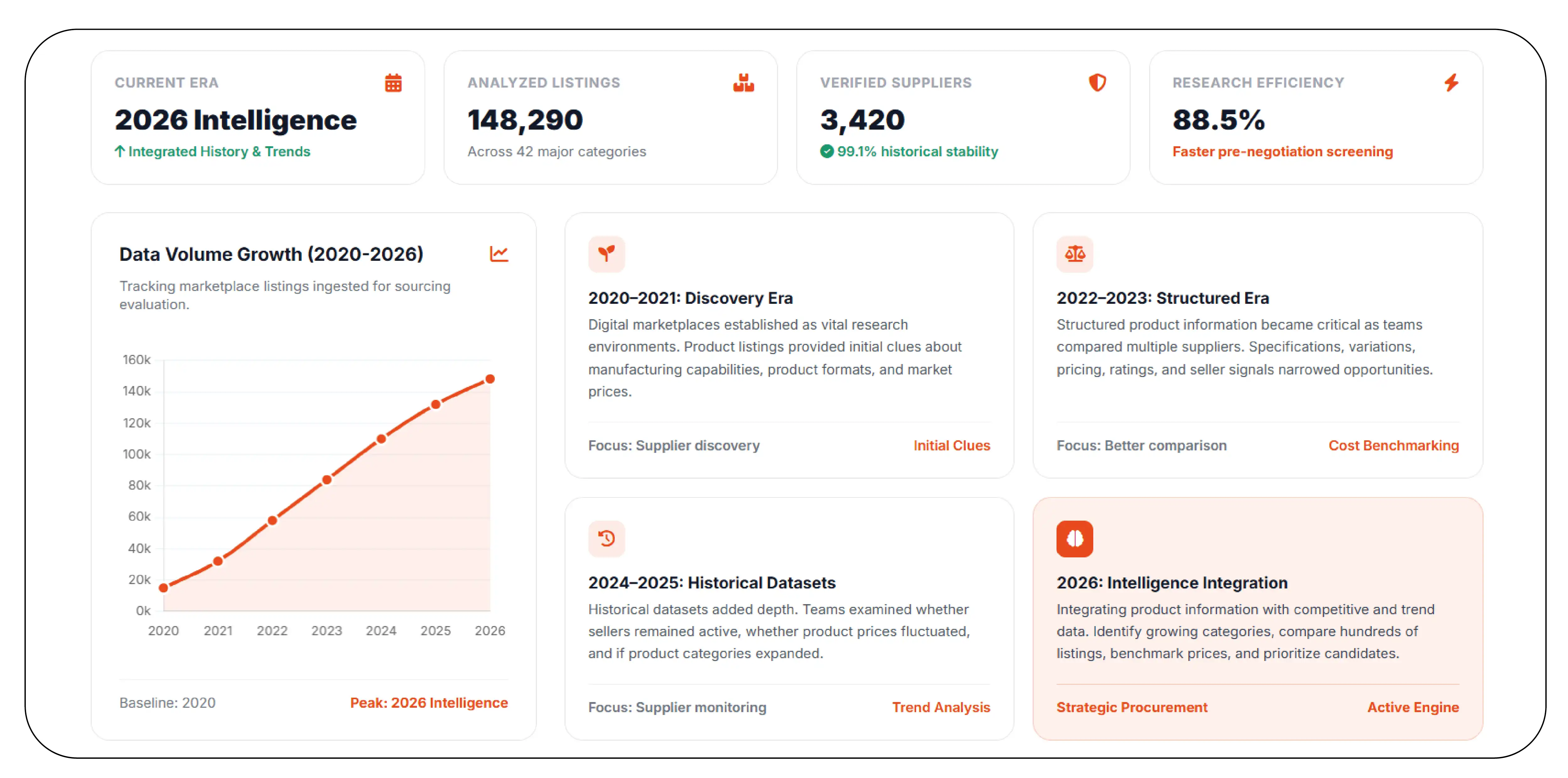
Global sourcing teams need more than product links. They require structured information that allows products to be compared consistently. Taobao Product Catalog Scraping for Sourcing can help transform large volumes of marketplace listings into datasets suitable for supplier discovery, product comparison, and category research.
| Year | Sourcing Data Evolution | Core Information | Main Benefit |
|---|---|---|---|
| 2020 | Listing-based sourcing | Product and seller | Supplier discovery |
| 2021 | Structured research | Product attributes | Better comparison |
| 2022 | Detailed product analysis | Specifications and variants | Product evaluation |
| 2023 | Competitive sourcing | Price and seller signals | Cost benchmarking |
| 2024 | Historical sourcing | Product changes | Supplier monitoring |
| 2025 | Automated collection | Multi-category datasets | Research efficiency |
| 2026 | Intelligence-driven sourcing | Product, price and seller history | Strategic procurement |
The 2020–2021 period established digital marketplaces as important research environments for sourcing teams. Product listings could provide initial clues about manufacturing capabilities, product formats, and market prices.
During 2022 and 2023, structured product information became more important as sourcing teams compared multiple suppliers offering similar products. Product specifications, variations, pricing, ratings, and seller information could help narrow down potential opportunities.
By 2024 and 2025, historical datasets added another dimension. Teams could examine whether sellers remained active, whether product prices changed, and whether certain product categories continued to expand.
In 2026, sourcing intelligence can integrate product information with competitive and trend data. A sourcing team might identify a growing product category, compare hundreds of listings, benchmark prices, examine product specifications, and prioritize candidates for further supplier validation.
This approach does not replace supplier due diligence. Instead, it improves the research stage by helping businesses identify promising products and suppliers before investing significant time in direct negotiations, samples, audits, or logistics assessments.
The result is a more systematic sourcing workflow in which marketplace intelligence becomes the starting point for deeper commercial evaluation.
Creating a Cross-Border View of Marketplace Opportunities
Extract Cross-Border Marketplace Product Data provides global brands with a structured way to examine product availability, pricing, assortment, sellers, and market signals within an international sourcing context. The broader Taobao Cross-Border Product Data Report 2026 demonstrates how repeated marketplace intelligence can help companies make more informed decisions in a rapidly changing global commerce environment.
| Year | Cross-Border Intelligence Priority | Data Requirement | Strategic Outcome |
|---|---|---|---|
| 2020 | Digital sourcing | Product discovery | Broader supplier research |
| 2021 | Market expansion | Product and seller data | International opportunity mapping |
| 2022 | Product benchmarking | Price and specifications | Cost comparison |
| 2023 | Competitive research | Assortment and seller signals | Market positioning |
| 2024 | Trend discovery | Product history | Innovation planning |
| 2025 | Automated intelligence | Multi-dimensional datasets | Faster research |
| 2026 | Integrated cross-border intelligence | Product, price, trend and seller data | Strategic sourcing decisions |
China's trade scale provides an important backdrop for this type of research. Official customs data shows that China's total exports and imports reached approximately US$6.35 trillion in 2025, with exports increasing 5.5% year over year.
From 2020 through 2022, businesses were increasingly adapting to digital sourcing and cross-border purchasing environments. During 2023 and 2024, greater access to structured marketplace data made it easier to compare product categories and identify competitive opportunities.
In 2025 and 2026, the focus has shifted toward intelligence rather than simple data collection. Brands need to know not only what products exist, but which products are becoming more prominent, how their prices change, how sellers position them, and how product assortments evolve.
A cross-border marketplace dataset can support several business functions simultaneously. Product teams can use it for innovation research. Procurement teams can use it for supplier discovery. Pricing teams can benchmark market levels. E-commerce teams can analyze assortment and positioning.
This creates a unified intelligence layer connecting sourcing research with broader commercial strategy. For brands entering new markets, such information can shorten the early research cycle and help prioritize opportunities for further validation.
Why Choose Product Data Scrape?
Product Data Scrape can support brands and sourcing teams that need structured marketplace intelligence rather than manually collected product links. Cross-border product research often involves large numbers of listings, changing prices, different product variations, seller information, and extensive category structures.
The ability to Track Digital Shelf information can help businesses understand how products are presented, positioned, priced, and made visible within digital commerce environments. Structured datasets can then be organized by category, seller, brand, product type, price range, rating, or other business-specific attributes.
For international brands, this can improve product discovery and competitive benchmarking while reducing repetitive manual research. Historical collection can also create a valuable reference dataset for identifying changes in product assortments, price levels, and market trends.
Product Data Scrape can further support customized data pipelines, dashboards, exports, and research workflows depending on the business requirement. By turning marketplace information into organized datasets, teams can spend less time collecting information and more time interpreting the commercial opportunities behind it.
Conclusion
Cross-border product intelligence is becoming increasingly important as global brands look for faster ways to identify sourcing opportunities, evaluate categories, understand pricing, and anticipate product trends. Taobao's extensive marketplace environment provides a valuable source of product-level information that can support these objectives when collected and structured systematically.
From 2020 to 2026, marketplace research has evolved from basic product discovery toward multidimensional intelligence. Businesses now require information about products, specifications, prices, sellers, variations, discounts, ratings, availability, and historical changes.
Catalog Enrichment Services can help businesses convert raw product information into cleaner, standardized datasets that are easier to compare, analyze, and integrate into internal systems. Combined with the Taobao Cross-Border Product Data Report 2026, this approach provides a framework for understanding product ecosystems, sourcing opportunities, pricing movements, and emerging market signals.
The future of global sourcing will increasingly depend on the ability to identify meaningful signals quickly and convert them into actionable decisions. Brands that build structured marketplace intelligence capabilities can improve product discovery, strengthen competitive research, optimize sourcing workflows, and respond more effectively to changing international demand.
Ready to transform Taobao marketplace data into actionable cross-border sourcing intelligence? Partner with Product Data Scrape to build scalable product data solutions tailored to your catalog, pricing, sourcing, and competitive research requirements!
Source : https://www.productdatascrape.com/taobao-cross-border-product-data-report-2026.php
Original https://www.productdatascrape.com
#TaobaoCrossBorderProductDataReport2026,
#TaobaoProductIntelligenceForInternationalBrands,
#TaobaoProductCatalogDataScraping,
#TaobaoPriceMonitoringForGlobalBrands,
#TaobaoProductTrendIntelligenceForBrands,
#TaobaoProductCatalogScrapingForSourcing
📩 Email: sales@productdatascrape.com


Comments
Post a Comment